Series Conclusion: What Prototype-First ECU Development Is Really About
This series is now complete.
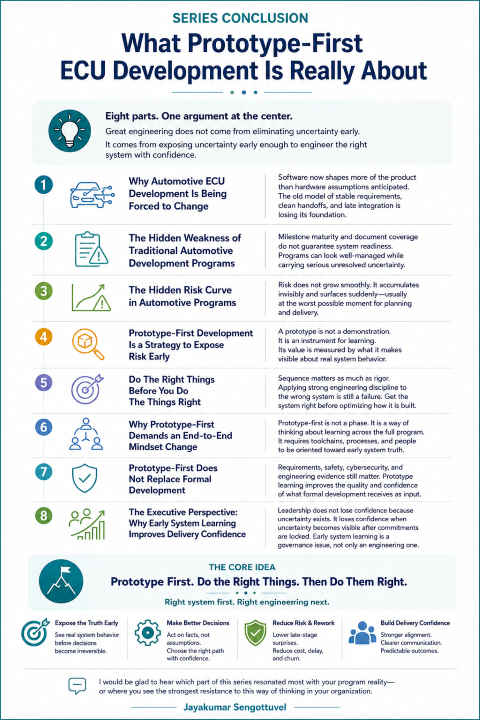
Eight parts. One argument at the center.
Automotive programs do not usually fail because teams lack discipline or because engineers are not working hard enough. They fail because the most important truths about the system arrive too late — after commitments are locked, timelines are compressed, and the cost of changing course is already high.
Prototype-first development is a strategy to change that timing.
Not by removing rigor. Not by making programs less structured. But by putting real, integrated system behavior in front of engineering and leadership decisions before those decisions become hard to reverse.
The Argument Across Eight Parts
-
Why Automotive ECU Development Is Being Forced to Change
Software now shapes more of the product than hardware assumptions anticipated. The old model of stable requirements, clean handoffs, and late integration is losing its foundation. -
The Hidden Weakness of Traditional Automotive Development Programs
Milestone maturity and document coverage do not guarantee system readiness. Programs can look well-managed while carrying serious unresolved uncertainty. -
The Hidden Risk Curve in Automotive Programs
Risk does not grow smoothly. It accumulates invisibly and surfaces suddenly — usually at the worst possible moment for planning and delivery. -
Prototype-First Development Is a Strategy to Expose Risk Early
A prototype is not a demonstration. It is an instrument for learning. Its value is measured by what it makes visible about real system behavior. -
Do The Right Things Before You Do The Things Right
Sequence matters as much as rigor. Applying strong engineering discipline to the wrong system is still a failure. Get the system right before optimizing how it is built. -
Why Prototype-First Demands an End-to-End Mindset Change
Prototype-first is not a phase. It is a way of thinking about learning across the full program. It requires toolchains, processes, and people to be oriented toward early system truth. -
Prototype-First Does Not Replace Formal Development
Requirements, safety, cybersecurity, and engineering evidence still matter. Prototype learning improves the quality and confidence of what formal development receives as input. -
The Executive Perspective: Why Early System Learning Improves Delivery Confidence
Leadership does not lose confidence because uncertainty exists. It loses confidence when uncertainty becomes visible after commitments are locked. Early system learning is a governance issue, not only an engineering one.